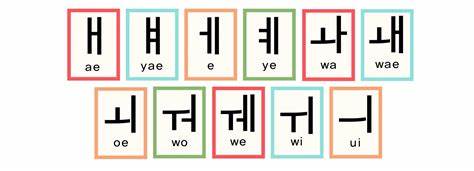
After mastering the 10 basic vowels of Hangeul, it’s time to meet the next family of sounds: double vowels.
These vowels are created by combining two simple vowels, and they often sound like a smooth glide from one vowel to another.
The good news is: if you understand the basics, double vowels are easy to learn because they follow clear patterns.

When you first begin learning Korean, the 10 basic vowels (ㅏ, ㅑ, ㅓ, ㅕ, ㅗ, ㅛ, ㅜ, ㅠ, ㅡ, ㅣ) give you the foundation. But to speak Korean naturally, you need to go one step further: the 11 double vowels.
Double vowels are sounds where two vowels glide smoothly within a single syllable, almost like a short “journey” in one breath. They may look complicated at first, but they follow simple and logical patterns. If you keep two golden rules in mind, they’ll become much easier:
- Pronounce them smoothly in one syllable length (don’t split into two).
- Keep mouth shape continuity (don’t break the movement suddenly).
Below, each double vowel is explained in detail: components, IPA, mouth shape, tongue position, common mistakes, and practice words.
1) ㅐ (ae) = ㅏ + ㅣ
- IPA: [ɛ] (close to “e” sound)
- Mouth: Open slightly sideways, tongue low and front.
- Tip: Like e in bed, but a little more open.
- Mistake: Mixing it with ㅔ — in daily speech they sound similar, but ㅐ should be slightly more open.
- Examples: 개 (gae, dog), 새 (sae, bird), 내일 (naeil, tomorrow)
2) ㅒ (yae) = ㅑ + ㅣ
- IPA: [jɛ]
- Mouth: Short [j] glide, then ㅐ.
- Tip: Like saying “yeah” quickly — not drawn out “예~,” but short “얘.”
- Examples: 얘 (yae), 얘기 (yaegi, story)
3) ㅔ (e) = ㅓ + ㅣ
- IPA: [e̞] ~ [e]
- Mouth: Slightly narrower than ㅐ, jaw relaxed.
- Tip: Similar to e in set, but slightly more closed.
- Examples: 세 (se, three), 세계 (segye, world)
4) ㅖ (ye) = ㅕ + ㅣ
- IPA: [je]
- Mouth: Short [j] glide + ㅔ.
- Tip: Just like ye in yes.
- Examples: 예 (ye, example), 예술 (yesul, art), 예약 (yeyak, reservation)
5) ㅘ (wa) = ㅗ + ㅏ
- IPA: [wa]
- Mouth: Round lips (ㅗ) → smoothly open wide (ㅏ).
- Tongue: Moves slightly forward.
- Tip: Don’t say “woo-ah” separately; keep it short and smooth.
- Examples: 와 (wa, come), 과자 (gwaja, snack), 좋아 (joh-a, good)
6) ㅙ (wae) = ㅗ + ㅐ
- IPA: [wɛ]
- Mouth: Round lips for ㅗ → then open sideways (ㅐ).
- Note: 왜(wae), 외(oe), 웨(we) often sound similar in daily speech. Learn to distinguish by spelling.
- Examples: 왜 (wae, why), 왜요 (waeyo, why polite)
7) ㅚ (oe) = ㅗ + ㅣ
- IPA: Traditionally [ø], but in modern speech often [we].
- Mouth: Keep lips rounded; glide toward a closed sound.
- Tip: 외/왜/웨 may all sound alike in real conversation. Spelling carries the meaning.
- Examples: 외 (oe, outside), 외국 (oeguk, foreign country), 외교 (oegyo, diplomacy)
8) ㅝ (wo) = ㅜ + ㅓ
- IPA: [wʌ] ~ [wɔ]
- Mouth: Round lips (ㅜ) → relax into ㅓ.
- Tip: Don’t pronounce “woo-uh”; keep it one glide.
- Examples: 원 (weon, origin), 무엇 (mueot → closer to [mwʌt]), 원하다 (wonhada, to want)
9) ㅞ (we) = ㅜ + ㅔ
- IPA: [we]
- Mouth: Rounded ㅜ → narrow ㅔ.
- Tip: Very close to English we, but smoother in one syllable.
- Examples: 웹 (wep, web), 웨딩 (weding, wedding)
10) ㅟ (wi) = ㅜ + ㅣ
- IPA: [wi] (sometimes [ɥi])
- Mouth: Rounded lips (ㅜ) → spread into a smile (ㅣ).
- Tip: Similar to English we, but shorter and more compact.
- Examples: 위 (wi, above), 위치 (wichi, location), 위험 (wiheom, danger)
11) ㅢ (ui) = ㅡ + ㅣ
- IPA: Word-initial [ɰi]/[ɯi]; after consonants often [i]; as a particle, often [e].
- Mouth: Flat lips (ㅡ) → glide into smile shape (ㅣ).
- Position tips:
- At word start: 의자 [ɰi.ja] (uija, chair)
- After consonant: often [i] (거의 geo-i → [geoi])
- As particle (의 = “of”): often pronounced [e] in daily speech.
- Examples: 의자 (uija, chair), 의미 (uimi, meaning), 의사 (uisa, doctor)
Common Confusions
- ㅐ vs ㅔ: Sound similar in daily speech, but ㅐ is more open.
- 왜(ㅙ), 외(ㅚ), 웨(ㅞ): Often pronounced [we], but written forms = different meanings.
- ㅢ: Can shift to [ui], [i], or [e] depending on position.
Quick Pronunciation Routine (5 minutes)
- Glide Practice
- w-glides: 우→아 (wa), 우→어 (wo), 우→에 (we), 우→이 (wi)
- o-glides: 오→아 (wa), 오→에 (wae/oe)
- Minimal Pairs
- 개 (gae) vs 게 (ge)
- 왜 (wae) vs 외 (oe) vs 웨 (we)
- One Breath Rule
- Say in one glide, not two: 워 [wʌ], 웨 [we], 위 [wi]
- Mini Sentences
- 왜요? (Why?) / 외워요. (I memorize.)
- 웹에서 위키를 봐요. (I look at a wiki on the web.)
- 의자의 위치가 왜 거기예요? (Why is the chair there?)
Summary Table
| Vowel | IPA | Mouth Tip | Example |
|---|---|---|---|
| ㅐ | [ɛ] | More open than ㅔ | 개 (dog) |
| ㅒ | [jɛ] | Short y + ae | 얘 (hey) |
| ㅔ | [e̞] | Narrower than ㅐ | 세 (three) |
| ㅖ | [je] | Short y + e | 예 (example) |
| ㅘ | [wa] | Round → open | 와 (come) |
| ㅙ | [wɛ] | Round → sideways | 왜 (why) |
| ㅚ | [we]/[ø] | Round lips, “we”-like | 외 (outside) |
| ㅝ | [wʌ] | Round → relax | 원 (origin) |
| ㅞ | [we] | Round → e | 웹 (web) |
| ㅟ | [wi] | Round → smile | 위 (above) |
| ㅢ | [ɰi]/[i]/[e] | Flat → smile | 의자 (chair) |
🌸 Final Thought
Double vowels are like a “short journey inside one syllable.” If you remember the starting and ending mouth shapes and glide gently without breaking, Korean double vowels will soon feel like the natural melody of the language.
 Laura's Korean Story
Leave a comment